Tuesday, April 8, 2014

Cultivating Confidence -- from an earlier post

Whenever I get ready to call my parents these days, I have to psych myself up.  Not because I don’t want to talk with them, but because I know I have to bring my “A” game to the conversation.  If I want to complain about something, I need to be prepared to troubleshoot; if I have news to share, I need to be prepared with lots of information.  Once we’re talking, it’s wonderful!  But it’s been this way for as long as I can remember. 
Growing up, my mother had a knack for asking the one question I could not answer. Not in a bad way, though— it was as though she believed I had the answer or could find it. Both her and my dad also made a point to praise my successes as they observed them. And for all the things I was bad at (and there was plenty; still are) they were great at acknowledging my frustration while simultaneously redirecting and encouraging me. They were both (and still are) amazing at accentuating the positive without ignoring the negative. They inspired confidence!
I received a gift from a parent my last year in New Jersey. It was a token of her appreciation, but it was the note that came with it that I appreciated most— it read, “You instill confidence.” As an educator, this was the best compliment I could receive and I didn’t even know it until I read it. 
Since then, I’ve spent a lot of time thinking about how I encourage students, what is possible through coaching and how asking the right questions can motivate students to not only find answers but also try new learning strategies on their own. In a lot of ways, this is essentially what my parents did for me but with greater focus on skill-building.  Giving students an opportunity to reflect on their attempts and intentions allows them to better understand their potential, identify gaps in their developing skills and determine how to best close those gaps. Since receiving that inspiring thank you note a year ago, I believe this is what instilling confidence is all about. It also happens to be the action plan associated with Assessment for Learning, heralded by Rick Stiggins, Jan Chappuis and others in Portland, Oregon as part of the Assessment Training Institute.
I always go back to Vygotsky’s Zones of Proximal Development when I assess what could work for students and what’s not working.  I have to listen to their routines and their habits to find “windows” of opportunity for improvement.  If I can point out patterns to their routine or regularities in their habits, we’ve pinpointed that window.  I often start with asking about preferences: time or task?  This, in the context of a desired short-range goal—prepping for cumulative exams or embarking on a long-term research project, for example—provides the laboratory for experimentation.  If they seem more task oriented, we start there; if time boundaries appeal, we start there. Always, though, this starts as a conversation.
By the end of the conversation, the student and I have worked together to identify specifics related to task, time, outcome and how to begin. We are deliberate about these specifics, always committing them to writing using language that speaks to what the student can and wants to do and how to best leverage what already works.  We end our session agreeing to check-in and debrief on the plan.Then, when I see students in the hall, outside of school or on their way in or out, I like to think that seeing me reminds them of the commitment they’ve made to themselves and the confidence I have that they can do what they have expressed a desire to accomplish.

Friday, September 13, 2013

Technology on a Sunday Afternoon: Virtual space maintains actual connections

Family visits on Sunday afternoons often rely on technology these days.  Now that we don't live within driving distance, Skype sessions with grandparents are a new norm.  A text from my brother, "you there?" precedes a phonecall that results in a quick chat to catch up with the family.  Later in the day, or perhaps tomorrow, I'll text my sister to say hello and send a HUG -- I'm really not much for talking, but it's great to reach out and stay connected.  The draft on Sunday, however, took the whole "staying connected" thing to another level.
Joe and I rushed home from the grocery store after church two weeks ago Sunday, just in time for the 1 p.m. Fantasy football draft.  Bob was connected to his HP laptop, Matt sat on the couch with his MacBook Air, and Joe went bounding upstairs to the iMac to log in and get started.  Online, via Skype was Uncle Mike (in LA). But Google hangout allows for multiple participants for free, so.... Matt was generating invites as the draft began.
"Your team is on the clock" echoed upstairs and down.  I could hear all three computers, and the unknown voice inside the machines helped me keep tabs on who was picking when.  The "old" HP froze and cost Bob a pick or two, so he switched to the iPad, leaving the computer up for Skyping once it rebooted.  In between the smack talk and laughter, the boys were choosing teams, separate but together, participating in a visit and an event despite the miles that separate LA from Chicagoland. Grandpa lives in Tennessee and the Frasco cousins are in Maryland -- they were invited to the video call, but focused only on the draft.  We were bicoastal, with one foot in the midwest and another in Dixie.
As the hour went by, I heard Matt giving Uncle Mike step-by-step directions for shifting from the Skype call to Google+.  Once the four of them were all in the same chat room, the fun really began!  Matt, as the initiator and chief IT guy for the forum, started using special effects -- sounds and sights to make us laugh and perhaps even distract from the task at hand.  Ensuring productivity, "Your team is on the clock," announced repeatedly from around the circle.  Occasionally, I heard an "oh shoot! It's my pick."  Other times it was, "who's left?"  There were party hats and viking horns floating on top of heads in the hangout, and plenty of echo-y sound effects that proved annoying for some, but generally just entertaining.
This level of visiting, despite the distance really took me back -- to the days of casual visits with purpose; when relatives lived nearby, and you never knew who would drop by, but you were always glad to see them.  That Sunday,  I was reminded more of our in-person time, with cousins, aunts, uncles and grandparents as our mostly-empty house echoed with the laughter and fun only family shares during the rarest and yet most normal of occasions-- being gathered in one place.  Only this time, the one place was virtual.  Virtual space providing actual connection... think of that!

Tuesday, September 3, 2013

Quiet, by Susan Cain -- intro to a book review

Always start with something personal.  "It's more meaningful," they say: Matt is quiet, easily overstimulated, and yet a good conversationalist and an eager learner. They say I'm quiet too -- always have been. I listen intently, always interested in the world around me, and very observant.  I'm not shy, though I don't like crowds. I don't tend to speak up unless I have something important to say, and I HATE being somewhere for no reason.

My willingness to listen and keen observation skills have yielded what my husband refers to as a "Cliff Clavin-like" sense of expertise on a variety of topics. I'm good at Trivial Pursuit, but not a big fan of board games or party games -- I have to be in the right mood.  I hold on to and reflect on other peoples' worlds, forming opinions and offering advice, which is what I think makes me a good counselor.

Matt on the other hand, loves games, thinks strategically and logically and appears to be much more "in his head" than in the world.  We are both quiet, yet our introverted natures differ.  I reached for Susan Cain's book as means to understand better how to parent Matt and help him relate in a world of talkers. What I also discovered while reading were ways to articulate more about me and to consider how I relate with the world.

Cain provides an elaborative mix of case examples and research studies, along with quotes and ideas that speak to both head and heart.  She introduces us to some VERY effective introverts as well as the researchers who inform who and why we matter.

It's Chapter 6 that I marked for Matt to read: Why Franklin was a politician but Eleanor spoke out of conscience: Why Cool is Overrated.  When I explained what I had read and why he might want to take a look, his interest piqued a little -- with eyebrows raised and a bright expression on his face, he said "cool!"  This from a 15 1/2 year old boy!  I heard and saw a connection, despite the single-syllable utterance.

I think what I appreciate most about the book is Cain's insistence that the complementary nature of introverts and extroverts yields the best possible outcomes; the inextricable link that's the yin/yang ideal. Cain notes that different situations and/or circumstances require different strengths.  She points out the necessity for balance, citing examples, like the financial crisis caused by institutions "too big to fail" which illustrates what happens when risk-tolerant, impulsive types are not checked by the risk-averse, perspective-taking thinkers. She also acknowledges the value of cultivating habits that support realizing one's dream and/or cultivating a passion that requires extrovert-like skills.  She calls the animated, public-speaking, sociable roles we play, putting on an extrovert persona. Cain harps on the necessary acts of extroversion that are part of pursuing a dream, while reminding the introverted reader to be true to herself. "Figure out what you are meant to contribute to the world and make sure you contribute it. If this requires public speaking or networking or other activities that make you uncomfortable, do them anyway.  But accept that they're difficult, get the training you need to make them easier, and reward yourself when you're done." (p. 265)

Cain's primary objective in publishing Quiet and proceeding to promote it appear to be about articulating the value of being an introvert.  She provides a litany of role models and examples that one who is deemed quiet might aspire to be. She captures Eleanor Roosevelt's nature as complementary to Franklin's and captures Professor Little's seemingly multiple personalities as "just right" for the contributions they've made.  The book also reassures and proclaims the value of introverts to a world that just now appears to be swinging back from an over-reliance on the extrovert ideal.  Maybe my awareness has been heightened, but I'm hearing more about taking stock of the value of those who are more contemplative, persistent, sensitive and/or serious.

Susan Cain highlights the value of a "both...and..." world, raising the status of introverts such that extroverts and introverts alike can appreciate the power of Quiet.

Tuesday, January 22, 2013

Teaching & Learning: the diplomacy of education

I recently had a conversation with our communications manager.  "What's your angle?" he asked.  I wasn't sure at first how to answer, but he kept talking:  "You seem to have a good sense of what's happening in schools these days and how teachers work to deliver effective curricula."  Yes, I guess I do --  I'm also well aware of the psychological toll struggling students can have on conscientious teachers.  Just as I work from the perspective that "students do well if they can," (Ross Greene) I've known enough teachers professionally to believe that teachers teach well if they can.  And so, I guess, THAT's my angle -- negotiating the expectations and competencies of learners, whether they are teachers or students, so that learning can proceed.  Learning occurs as a direct result of identifying and filling gaps -- of skill, strategy and/or knowledge. Often times acknowledging the gap(s) can be scary, and figuring out how to address them, overwhelming.  BUT this is what I can do!  And, I'm told, I do it very well...

My number one mentor in college, Dr. Gersham Nelson, told me repeatedly that I needed to go into diplomacy.  He spoke about the foreign service and my passion for Latin America, but what I discovered, thanks to my graduate work in educational policy, study in a few Chicago public high schools and classroom work for more than ten years, was that there's plenty of room for diplomacy within our educational institutions. And so, here's my proposal:

 --  Maintain a blog that allows for learning about learning.  Presuming that teachers, parents, students and administrators alike are willing to learn, you are my audience.  As I assume goodwill on the part of each constituent, my purpose is to keep the student at the center of the conversation and to engage in and respond to the puzzles of teaching and learning. I invite you to ask questions, pose problems and/or share ideas that promote perspective-taking and knowledge building.

 Please let me know what you'd like to talk about.

Wednesday, January 4, 2012

Negotiating Teacher Expectations (and acknowledging your own)

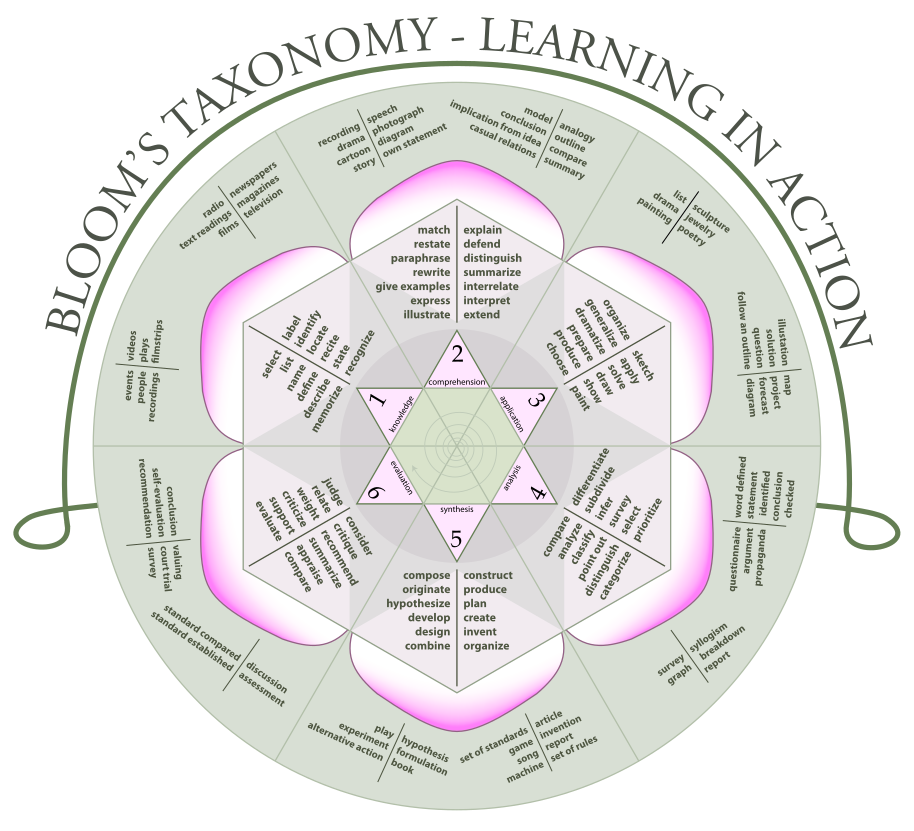
Many years ago, when I started working as an Educational Counselor at the University of Chicago, my mentor introduced me to Bloom's taxonomy of educational objectives.  As I worked to understand the categories to inform my work with students, I had a bit of an epiphany regarding HOW to dig in to assignments and opportunities to learn regardless of interest.  It was the "A-ha" moment I wished I had experienced years before; The language and understanding that help interpret course syllabi, authors' notes, project and/or research assignments, etc., etc. would have made a difference, particularly in the courses that I dreaded. Using the categories was like receiving a key to unlock the mystery of what many good teachers ask of their students.  I started sharing the document I created with students as we worked together to identify teacher expectations within a course or assignment AND opportunities for personal investment (comment or email me to request the full document as a pdf):


-->
Teachers usually have specific reasons for the assignments they offer.  Each assignment enables the student to utilize specific thinking skills.  The background, directions and explanations the teacher gives with the assignment often indicate his/her expectations for student learning.  Many times, a grade will reflect the degree to which the teacher is satisfied with the learning, and/or the degree to which the student has demonstrated his/her ability to apply the appropriate thinking skills.

After so many years of using the document and approaching course expectations through the lens of identifying expectations, when I started teaching in the classroom I had no problems articulating learning goals and/or course objectives for my students.  That doesn't mean they could identify them any more readily on their own, but I could then use my Bloom's Taxonomy key to help them understand the depth and level of understanding that I expected from them.  It provided a means for me to communicate expectations for time, energy and depth of engagement.
 
Students also have reasons for completing assignments (other than the obvious necessity of passing the course).  As the student interprets the assignment, he/she must identify some objectives for learning and determine the thinking skills necessary to complete them.  Doing so will not only enable him/her to better meet the teacher’s expectations, but can also result in greater motivation to complete the assignment effectively


It's the motivation that will drive learning.  I have recently learned a new phrase that perhaps captures the source of the intrinsic motivation that most good teachers try to tap into as they design curriculum and assign learning tasks -- epistemic curiosity.  Shared by Jennifer Mangels, Ph.D. during a presentation at the Learning and the Brain conference I attended last year in Chicago, epistemic curiosity is "an emotional or motivational condition that creates the drive for knowledge-seeking, potentially suppressing anxiety and fear that might arise in the face of uncertainty or even failure (from her website)


Providing the time and space for students to consider their own learning objectives (targets, if you will) AFTER helping them to understand the goals or objectives of the teacher (author, presenter, lecturer, guide) can often ensure that students can make active (or intentional) decisions about how, when, why and for how much they engage in the learning process.  It can also help the learner prioritize tasks and gauge level of engagement.


[A later topic to explore... Trust -- How students' relationships with their teacher, their tutor, their coach, their parent, etc. can inform and motivate achievement that is personally satisfying and can drive learning]

Monday, January 2, 2012

Tuesday, 1/2/2012 Almost back to school

This morning, I'm up by 6 (tomorrow will be 5), with the thought to write for 30 minutes -- first priority. The tea is made, the slippers are on and I've set up my stuff in the downstairs bathroom.  The goal still is to establish a morning routine that allows me to start the day with time and space to keep things in perspective -- to give myself time to write and to work on professional focus.  There's been much time to think these past two weeks, and as the New Year begins, yet again, I'm determined to make progress.
Today, I will finalize, to the best of my ability, the calendar for January, work on a communication plan to suggest to Bob and gather the phone numbers of the professionals to call this week.  There! The rule of three prevails -- identify three things to accomplish -- let these be the priorities and then the distractions... I'm sure I'll think of other things, but for now these three are it!

Since it is Monday, we'll have a drum lesson and Lifetime activities later today.  As we prepare for back to school tomorrow, the boys will have some chores to do, but we should be able to do something "fun" to finish off the time off -- Hard to believe we're at the end.

In church yesterday, I really appreciated the cover of the bulletin -- the artwork was intriguing -- lovely in its simplicity, but as I stared at it, I found it satisfying due to the complexity of the composition -- and the message, is one for the year -- "Be strong and of a good courage... God is with thee"

Friday, December 30, 2011

Time Mangement -- Being deliberate about tasks

As a new year (2012) gets underway, I'm thinking about that sense of overwhelming that I know students feel when there is so much promise in their schedules, but there will be so much required of them in terms of meeting demands, keeping track of deadlines and understanding teacher expectations. The grace period is over -- We know what the expectations are, we have a sense of the pacing and perhaps, we've even become entrenched in routine or habits that are working for some courses, but not for others.

This year, since September, many students have worked to find their footing; some with greater success than others.  How students approach a problem, devise a solution and/or work to execute a plan to get things done will vary immensely depending on their mindset, their confidence and the support they perceive.  I think parental/societal pressures as well as the work ethic that develops also have huge implications in terms of determining how to best help a student be deliberate about tasks.  That said, a student's desire to succeed is the only motivating force that is worth leveraging -- with the intrinsic push and the implicit confidence that a student has or can borrow (from a coach, from peers, from a teacher, from a parent) there is nothing that can't be accomplished.

How to cultivate confidence? -- My mother always asked me the question I could not answer, not in a bad way though -- it was as though she believed I had the answer (or could find it). She also (and my dad too) praised me to no end in terms of explicitly noting what I was good at as she (they) observed it.  What I was bad at? ... WELL there was plenty  (still is), and I demonstrated adequate frustration, I'm sure (even sometimes rude behavior) such that neither of my parents needed to comment.  They did however, redirect and encourage.  My father let me watch a lot -- if I asked, he would explain what he was doing or why; sometimes, he would even express frustration -- that's when I would walk away -- not one to enjoy confrontation at all : )  However, he usually finished the job he worked on, and my mother, again would praise and express gratitude (this time to him AND whoever was helping).  They were both (and still are) GREAT at accentuating the positive without ignoring the negative.  They inspired confidence!

I received a gift from a parent last year that was a token of her appreciation, but it was the note that came with it that I appreciated most -- it said, "you instill confidence."  It was the best compliment I could receive, and I didn't even know it until I read it.  Since then, I've thought about how I encourage students, what is possible through coaching and how by asking the right questions I can lead students to find some answers and/or motivate them to try what might work. [I essentially do what my parents did, but with greater focus on skill-building.]  Giving students an opportunity to reflect on their attempts and their intentions allows them to realize some potential, identify gaps and determine how to close those gaps.   That's what instilling confidence is all about. [It also happens to be the action plan associated with Assessment for Learning, heralded by Rick Stiggins, Jan Chappuis and others in Portland, Oregon  as part of the Assessment Training Institute.]

I always go back to Vygotsky's zones of proximal development as I consider what could work for students and/or what's not working.  I have to listen to their routines and their habits to find "windows" of opportunity for improvement.  If I can point out patterns to their routine or regularities in their habits, we've pinpointed that window.  I often start with asking about preferences -- time or task?  This, in the context of a desired short-range goal -- prepping for cumulative exams comes to mind at this time of year, or embarking on the long-term research project, provides the laboratory for experimentation.  If they seem more task oriented, we start there; if time boundaries appeal, we start there.  ALWAYS, though, it is a conversation.

By the end of the conversation, together we've identified specifics related to task, time, outcome and how to begin -- We've been deliberate about these and put them to paper (usually a post-it), always using language related to what the student CAN do, WANTS to do and how to leverage what already works.  We end our session agreeing to check-in and debrief on the plan, and when I see students in the hall, outside of school or on their way in or out, I like to think that seeing me reminds them of the commitment they've made to themselves and the confidence I have that they CAN DO what they have expressed a desire to accomplish.

Inherent to their motivation to succeed, of course are the expectations; the societal and familial pressures that exist below the surface and inform our actions, our beliefs and our approach.  How to negotiate academic expectations with a nod to acknowledging social, familiar and personal pressure will be the next topic to cover...

Good morning -- day 2 ... every other day?

Here we are at Friday -- trying out the 30 minute rule; I just finished the email block and found myself "hurrying through" in anticipation of not knowing when time would be called.  Now I've successfully corresponded with 3 different colleagues/friends, caught up on some professional news and recording the banking events in my calendar -- this is a good start.
I flipflopped the timing -- email first this time; not sure why, but tomorrow (Saturday), I'll go the other way and see what works better.  The idea of flexibility with boundaries could work.
What remains to be done? -- hang the new drapes I bought for the living room; finalize the calendar for the month of January and draft the start to February.  I may even need to block out time for scheduling!  The goal on my post-it is to "establish a sense of order and routine" with 1 - 2 hours/day without distraction.  It took me three days to get to the bill paying though, so the distraction is something to work on for sure.
Mom went into the hospital VERY early yesterday morning; appears to be an infection stemming from a leg wound that won't heal.  The culture takes 48 hours for conclusive results as to what kind of infection, but the antibiotics she's getting intravenously seem to be doing some good. I hope she's able to get some rest.

Is there enough time in the day to get all the chores done and still feel like there's time to "chill" productively? -- What's my priority for today?  I think we need to get some exercise -- a little Lifetime, perhaps?  ...its cold out and it will be difficult to motivate the boys, but I think I can do it.

Action to Learn? --  How to establish and maintain boundaries within and beyond my professional life so that I feel productive AND satisfied? ...I have to remember that maintaining boundaries is particularly difficult as my professional passions lead me in various directions -- the focus must be on WHAT?

Wednesday, December 28, 2011

Good morning - day 1 - My Actions to Learn

Last night I lay awake, turning over the various thoughts and frustrations of the day. I've had almost two weeks off from work at school and am feeling like there is more and more work at home than I care to face.. But nonetheless, at some point I have to face it. There's a part of me, each month, that considers what to do about going back to school -- I'd like to pursue a Ph.D., but I am at a point in my family life, that I can't see adding one more thing on to my plate. Just to satisfy my longing, I do things to torture myself, like read the UChicago magazine or go online to to look at the various programs that are around. My reality is such that I should just pour myself into the work I do and be satisfied. There's plenty of it, for sure. I wrote yesterday to a friend and colleague that I am much better at helping others manage their academic lives and make task and time decisions than I am at helping myself.
I need a plan for the day, for the month for the year. This week -- the final days of 2011, can I resolve to put my MKA work into a box with an 8 hour boundary? to give myself the 1-2 hours a day to explore and write and edit my own professional life? to commit 2-3 hours a day to the household and my family obligations? to allow time for exercise and reading and enjoying the life for which I should be grateful -- my boys? I'm up to 11 hours already, leaving 2-4 more for the humdrum activities of transport and downtime.
New resolve -- 7:45 to 4:30 at school; set up the day first thing in the morning and communicate via email according to priorities. Sounds easy... not so much, I know from experience.
The variables over which I have little control -- moods, delays, distractions (okay, I have some control over that) and what I forget to communicate.
Trial run this week -- up by 6:00... push it to 5 next week as we head back to school.
3 repositories for "reminders and lists" -- iCal on the computer; paper calendar notebook; and the post-it list that sits on my laptop
I'll use the timer to do email in the a.m. -- 30 minutes; after writing for 15-30 minutes
Before "closing out the day" I'll preview the next day, check the calendar and create the list -- all this in an attempt to reign in some control, keep an eye on my priorities and realize some goals for 2012. This week I'll have to figure out what they are.

Saturday, January 24, 2009

Why Study is a 4-letter word

I find in my work that the overwhelming nature of the idea of STUDY regularly de-motivates students, despite their best intentions to BE SUCCESSFUL. Students often don't know where to start, or how to measure progress or even to know when they are done. As a result, there is no sense of PRODUCTIVITY, which can motivate. The various uncertainties often lead to procrastination and/or cramming in preparation for assessments -- both large and small. Because STUDYING is such an abstract concept, unless it is broken down into its constituent actions, students who are feeling overwhelmed or anxious or even disaffected will avoid it.

Whenever a student includes the word "study" as part of a plan to improve his or her grades or to prepare for a test or a quiz, I challenge the idea of "study" and encourage active, task-oriented verbs instead. For so many, "study" can be as passive as reading over notes or as active as practicing problems/questions. By asking a student to tell me what I would see if I were watching him/her study, I am able to pinpoint the reality of the task. I can then make suggestions for improvement and turn that picture into a specific task list. For example:

Trina has to study her notes to prepare for a quiz in History --
Q: If I were to watch you study, what would I see?
A: "I would be looking at my notebook and rereading what I wrote in class."

Q: Why are you rereading? -- What is the purpose?
A: "So I can remember what I learned."

At this point, I have learned that there is little active engagement, though Trina's intentions are matched nicely with the goal of preparing for the quiz. What's missing is the connection(s) Trina could make to her reading, her class discussion and/or lecture and what she's learned previously about the topic at hand. Also what is missing is the analytical thought that will improve her memory and network the newly incorporated material with what has been learned previously. After modeling some of this using the content in front of us, I can record a task plan for preparing for her history quiz that looks something like this:
  • From the notes, make a list of the key words and phrases that you want to USE to communicate your undersatnding of this topic
  • Compare your list from the notes to the related text reading or to the teacher's study guide and add other terms or phrases that you need to know
  • Using this list, talk through (or write) explanations that connect the terms and allow you to draw conclusions about how, when and why the terms are related
  • As you talk (or write), keep track of the questions that come up -- these will identify your knowledge gaps
  • Decide how to fill the knowledge gaps -- ask the teacher, ask a classmate, check the text or other course material, reference another reliable source
  • Once you are secure in your knowledge, try to predict the questions -- see how well you can answer them -- draft 2-3 multiple choice questions; write a few fill-ins; compose a short-answer or analytical essay question
  • Finally, check your knowledge by practicing -- use on-line resources for the text; quiz a classmate and/or ask them to quiz you
By breaking the process of studying into specific tasks, I have provided a step-by-step plan that can ensure Trina's study efforts result in longer-term retention of material with the shorter-term objective of ensuring successful performance on her assessment. The plan also addresses the problem of feeling overwhelmed by the prospect of studying.

Though this is only one example, the actions in red can be included in so many task plans -- whether for science, English literature, foreign language and/or math, to varying degrees. As this blog progresses, I will use other subjects as the contexts for examining the process of learning -- always with objectives in mind, and often in response to a problem that a student has posed.